What Are AI Tools and How Businesses Use Them
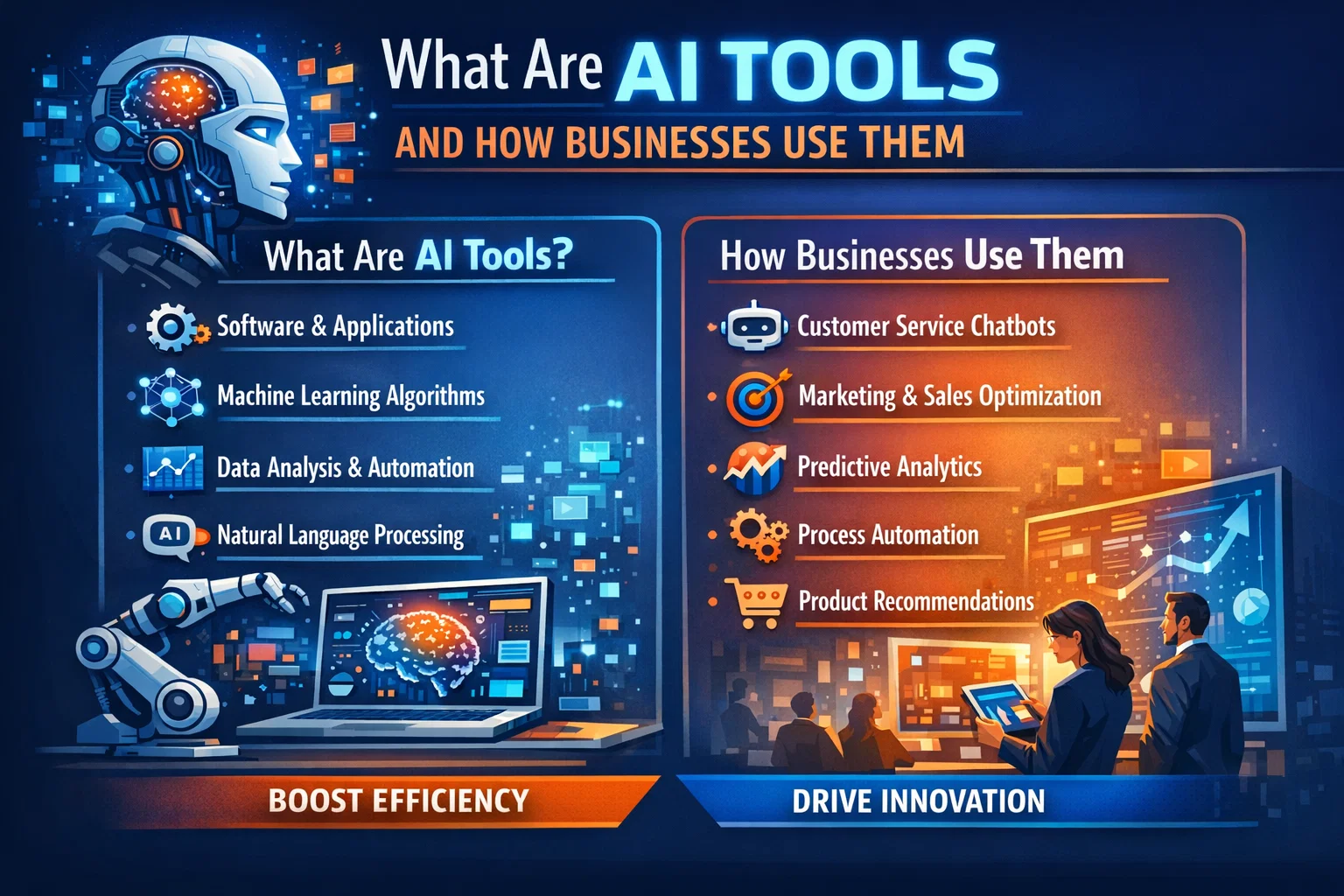
What Are AI Tools and How Businesses Use Them
Artificial Intelligence (AI) is no longer a futuristic concept—it is now a core driver of business growth, efficiency, and competitive advantage. Across Tier-1 countries such as the United States, United Kingdom, Canada, Australia, and Western Europe, businesses are investing heavily in AI tools for business to automate processes, reduce costs, and make data-driven decisions.
This comprehensive guide explains what AI tools are, how they work, and how modern businesses use them across industries to achieve measurable results and high return on investment.
What Are AI Tools?
AI tools are software applications that use artificial intelligence technologies—such as machine learning, natural language processing (NLP), computer vision, and predictive analytics—to perform tasks that typically require human intelligence.
Unlike traditional software, AI tools can:
- Learn from data
- Adapt to new information
- Automate complex decision-making
- Improve performance over time
This adaptability makes AI tools extremely valuable for modern enterprises.
Core Technologies Behind AI Tools
Machine Learning (ML)
Machine learning enables systems to learn patterns from data and make predictions without being explicitly programmed.
Natural Language Processing (NLP)
NLP allows AI tools to understand, interpret, and generate human language.
Computer Vision
This technology enables machines to interpret images and videos.
Predictive Analytics
Predictive models forecast future outcomes based on historical data.
Why Businesses Are Rapidly Adopting AI Tools
Businesses in high-value markets adopt AI tools for several strategic reasons:
- Operational efficiency
- Cost reduction
- Improved customer experience
- Data-driven decision-making
- Scalability
AI tools help organizations stay competitive in fast-changing markets.
Common Types of AI Tools for Business
AI Automation Tools
Automate repetitive tasks such as data entry, scheduling, and reporting.
AI Analytics Platforms
Analyze large datasets to uncover insights and trends.
AI Customer Support Tools
Chatbots and virtual assistants handle customer queries 24/7.
AI Marketing Tools
Optimize ad targeting, content creation, and customer segmentation.
AI Sales Tools
Predict lead quality and recommend next best actions.
How Businesses Use AI Tools
1. Process Automation
AI automates repetitive workflows, reducing human error and operational costs.
2. Data Analysis and Forecasting
AI tools analyze massive datasets faster and more accurately than humans.
3. Customer Experience Enhancement
Personalized recommendations and instant support improve satisfaction.
4. Fraud Detection and Risk Management
AI detects anomalies and suspicious activities in real time.
5. HR and Talent Management
AI assists in resume screening, employee engagement, and performance analysis.
Industry Use Cases of AI Tools
Finance
AI tools detect fraud, automate trading, and improve credit scoring.
Healthcare
AI assists in diagnostics, patient monitoring, and operational efficiency.
E-commerce
AI powers recommendation engines and dynamic pricing.
Manufacturing
Predictive maintenance reduces downtime and costs.
Marketing
AI improves ad performance, content personalization, and ROI.
AI Tools vs Traditional Software
| Aspect | Traditional Software | AI Tools |
|---|---|---|
| Learning Capability | None | Continuous learning |
| Decision Making | Rule-based | Data-driven |
| Scalability | Limited | Highly scalable |
| Automation | Basic | Advanced |
Benefits of Using AI Tools for Business
- Higher productivity
- Lower operational costs
- Improved accuracy
- Faster decision-making
- Competitive advantage
Challenges of Implementing AI Tools
Despite their advantages, AI tools come with challenges:
- High initial investment
- Data privacy concerns
- Skill gaps
- Integration complexity
However, the long-term benefits usually outweigh these challenges.
Why AI Tools Deliver High ROI in Tier-1 Countries
Businesses in Tier-1 markets prioritize:
- Efficiency at scale
- Advanced analytics
- Premium customer experiences
- Compliance and security
AI tools align perfectly with these priorities, making them high-value investments.
The Future of AI Tools in Business
Emerging trends include:
- Generative AI for content and code
- Autonomous business processes
- AI-driven decision intelligence
- Hyper-personalization
Businesses that adopt AI early gain a lasting competitive edge.
Final Thoughts
AI tools for business are transforming how organizations operate, compete, and grow. From automation and analytics to customer engagement and risk management, AI tools deliver measurable value and high ROI—especially in Tier-1 markets.
For businesses looking to scale efficiently and remain competitive, adopting AI tools is no longer optional—it is essential.
Comments (3)