AI Tools for Productivity: How They Save Time
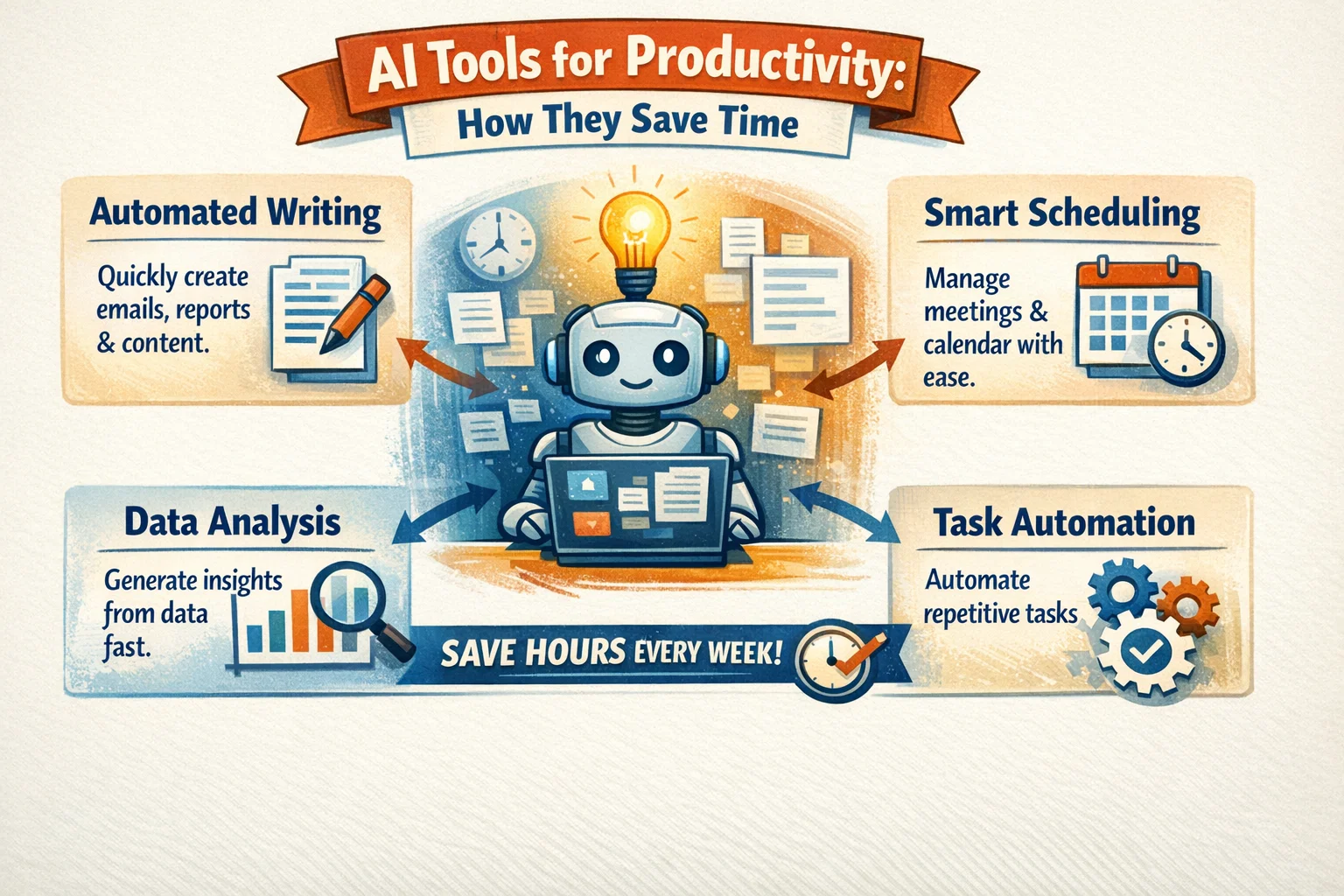
AI Tools for Productivity: How They Save Time
In today’s fast-paced digital economy, time is one of the most valuable business assets. Companies and professionals across Tier-1 countries like the United States, United Kingdom, Canada, Australia, and Europe are increasingly turning to AI productivity tools to work smarter, not harder.
Artificial Intelligence has fundamentally changed how work gets done. From automating repetitive tasks to enhancing decision-making, AI-powered productivity tools help individuals and organizations save time, reduce costs, and achieve better outcomes.
What Are AI Productivity Tools?
AI productivity tools are software solutions that use artificial intelligence technologies—such as machine learning, natural language processing (NLP), and predictive analytics—to optimize workflows, automate tasks, and improve overall efficiency.
These tools can:
- Automate routine and repetitive work
- Organize tasks and schedules intelligently
- Analyze data faster than humans
- Assist with writing, research, and communication
The result is more output in less time with fewer errors.
Why AI Productivity Tools Are Growing Rapidly
The demand for AI productivity software is booming due to several factors:
- Remote and hybrid work models
- Rising labor costs in Tier-1 markets
- Information overload
- Need for faster decision-making
AI tools address these challenges by acting as digital assistants that work continuously and intelligently.
How AI Productivity Tools Save Time
1. Automating Repetitive Tasks
One of the biggest time-savers is automation. AI tools can handle tasks such as:
- Email sorting and responses
- Data entry and validation
- Meeting scheduling
- Report generation
This frees up hours every week for employees to focus on high-value work.
2. Faster Content Creation and Writing
AI writing assistants help professionals draft emails, reports, blog posts, and marketing copy in minutes instead of hours.
They improve productivity by:
- Generating first drafts instantly
- Improving grammar and tone
- Optimizing content for SEO
This is especially valuable for marketing teams, content creators, and executives.
3. Smarter Task and Time Management
AI-powered task managers analyze workloads and priorities to suggest optimal schedules.
These tools can:
- Automatically prioritize tasks
- Send intelligent reminders
- Predict deadlines and risks
This ensures that important work gets done on time with minimal stress.
4. Improved Communication Efficiency
AI tools streamline communication by:
- Summarizing long emails and messages
- Transcribing meetings automatically
- Generating action items from discussions
This reduces the time spent reading, writing, and attending unnecessary meetings.
5. Faster Data Analysis and Decision-Making
AI productivity tools analyze large datasets instantly and present insights in easy-to-understand formats.
Businesses can:
- Make quicker strategic decisions
- Identify trends and opportunities
- Reduce analysis paralysis
Popular Categories of AI Productivity Tools
AI Personal Assistants
Manage calendars, emails, reminders, and daily tasks automatically.
AI Writing and Research Tools
Assist with content creation, summaries, translations, and research.
AI Project Management Tools
Optimize workflows, track progress, and predict project delays.
AI Meeting and Collaboration Tools
Automate meeting notes, summaries, and follow-ups.
AI Data and Analytics Tools
Convert raw data into actionable insights quickly.
AI Productivity Tools vs Traditional Productivity Software
| Aspect | Traditional Tools | AI Productivity Tools |
|---|---|---|
| Automation | Limited | Advanced and adaptive |
| Learning Ability | None | Continuous improvement |
| Decision Support | Manual | AI-driven insights |
| Scalability | Moderate | Highly scalable |
Industries Using AI Productivity Tools the Most
Technology and SaaS
For development workflows, customer support, and analytics.
Marketing and Advertising
Campaign optimization, content creation, and audience targeting.
Finance and Consulting
Data analysis, reporting, forecasting, and documentation.
Healthcare
Scheduling, documentation, diagnostics, and patient communication.
Education and E-learning
Content creation, grading assistance, and personalized learning.
Why AI Productivity Keywords Have High CPC and eCPM
AI productivity tools attract premium advertisers because:
- Businesses actively seek efficiency solutions
- High lifetime value (LTV) SaaS customers
- Strong adoption in Tier-1 countries
- Recurring subscription revenue models
This makes AI productivity content highly profitable for monetization.
Challenges of Using AI Productivity Tools
Despite their benefits, challenges include:
- Learning curve for teams
- Data privacy concerns
- Integration with existing tools
- Over-reliance on automation
Proper implementation and governance can mitigate these issues.
The Future of AI Productivity Tools
The future will see:
- More personalized AI assistants
- Deeper integration across platforms
- Autonomous workflow optimization
- Human-AI collaboration at scale
AI will become a core productivity partner rather than just a tool.
Final Thoughts
AI productivity tools are redefining how work gets done by saving time, improving accuracy, and enabling smarter decision-making. In competitive Tier-1 markets, adopting AI-powered productivity solutions is no longer optional—it is essential.
Organizations and professionals who leverage AI productivity tools today gain a significant edge in efficiency, performance, and long-term success.
Comments (3)